Delphi, Thermopylae full day private tour from Athens
Description
Highlights
- Day Trips
- Full-day Tours
- Historical Tours
- Low Last Minute Supplier Cancellation Rate
- Excellent Quality
- Short term availability
- Private Sightseeing Tours
- Walking Tours
- Bus Tours
- Worry-Free Shore Excursion
What makes this experience special
Language guide
Inglese
Transfer included
Raccolta in hotel / indirizzo
What's included
Included
- Private transportation
- Bottled water
- WiFi on board
- Professional drivers with deep knowledge of history (not licensed to accompany you in any site)
- Lunch (With Greek Traditional Food option)
- Air-conditioned vehicle
- Hotel/ airport/ port pickup and drop-off
Not included
- Licensed tour guide (upon request and depending on availability)
- Gratuities
- Delphi & Delphi Archaeological Museum (can be purchased on-site)
- Thermopylae Museum (can be purchased on-site)
Itinerary
- 1
Thermopylae is a place in Greece where a narrow coastal pass
Thermopylae is a place in Greece where a narrow coastal passage existed in antiquity. It derives its name from its hot sulphur springs. In Greek mythology the Hot Gates is one of the entrances to Hades. Thermopylae is the site of a battle between the Greek forces and the invading Persian forces, commemorated by Simonides of Ceos in the famous epitaph, "Go tell the Spartans, stranger passing by, That here obedient to their laws we lie." Thermopylae is the only land route large enough to bear any significant traffic between Lokris and Thessaly. To go from north to south along the east coast of the Balkan peninsula requires use of the pass, and so Thermopylae has been the site of several battles.
Pass by, no stop - 2
The Battle of Thermopylae was fought between an alliance of
The Battle of Thermopylae was fought between an alliance of Ancient Greek city-states, led by King Leonidas I of Sparta, and the Achaemenid Empire of Xerxes I. It was fought in 480 BC over the course of three days, during the second Persian invasion of Greece. The battle took place simultaneously with the naval battle at Artemisium. It occurred at the narrow coastal pass of Thermopylae ("The Hot Gates") in August or September 480 BC. The Persian invasion was a delayed response to the defeat of the first Persian invasion of Greece, which had been ended by the Athenian victory at the Battle of Marathon in 490 BC. By 480 BC, Xerxes had amassed a massive army and navy and set out to conquer all of Greece. The Athenian politician and general Themistocles had proposed that the allied Greeks block the advance of the Persian army at the pass of Thermopylae, while simultaneously blocking the Persian navy at the Straits of Artemisium.
30 min - 3
Leonidas was a king of the Greek city-state of Sparta, and t
Leonidas was a king of the Greek city-state of Sparta, and the 17th of the Agiad line, a dynasty which claimed descent from the mythological demigod Heracles and Cadmus. Leonidas was son of King Anaxandridas II. He succeeded his half-brother King Cleomenes I to the throne in c. 489 BC. Leonidas had a notable participation in the Second Persian War, where he led the allied Greek forces to a last stand at the Battle of Thermopylae (480 BC) while attempting to defend the pass from the invading Persian army; he died at the battle and entered myth as the leader of the 300 Spartans. While the Greeks lost this battle, they were able to expel the Persian invaders in the following year.
30 min - 4
Next to the monument of Leonidas, in the historic Thermopyla
Next to the monument of Leonidas, in the historic Thermopylae, lies the innovative museum of the Lamia Municipality, dedicated to the 480 BC battle that changed the course of Greek history.
1hAdmission not included - 5
Free time for a walk at: - sanctuaries of Apollo and Athena
Free time for a walk at: - sanctuaries of Apollo and Athena Pronaia - ancient stadium and theater
30 min - 6
An intriguing architectural marvel nestled within the archae
An intriguing architectural marvel nestled within the archaeological site of Delphi. Tholos provides us with a window into the ancient world and the rich tapestry of beliefs and traditions. The Tholos of Athena Pronaia is a circular building with a distinctive architectural design, featuring a ring of Doric columns surrounding a central chamber. Built in the 4th century BCE, this unique structure served as a sanctuary dedicated to Athena Pronaia, a variant of the goddess Athena worshipped in Delphi.
30 min - 7
Delphi Archaeological Museum is one of the principal museums
Delphi Archaeological Museum is one of the principal museums of Greece and one of the most visited. It is operated by the Greek Ministry of Culture. Founded in 1903, it has been rearranged several times and houses the discoveries made at the Panhellenic sanctuary of Delphi, which dates from the Late Helladic (Mycenean) period to the early Byzantine era. Organized in fourteen rooms on two levels, the museum mainly displays statues, including the famous Charioteer of Delphi, architectural elements, like the frieze of the Siphnian Treasury, and ex-votos dedicated to the sanctuary of Pythian Apollo, like the Sphinx of Naxos. The exhibition floor space is more than 2270m2, while the storage and conservation rooms (mosaics, ceramics, and metals) take up 558m2.
1hAdmission not included - 8
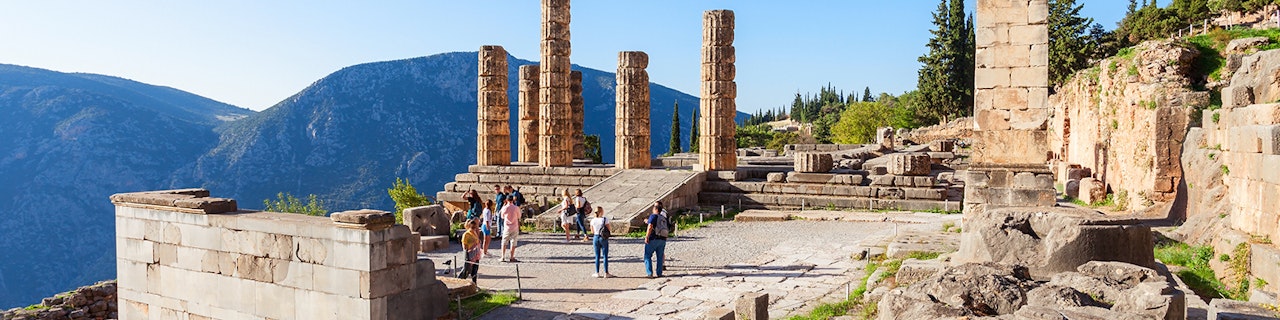
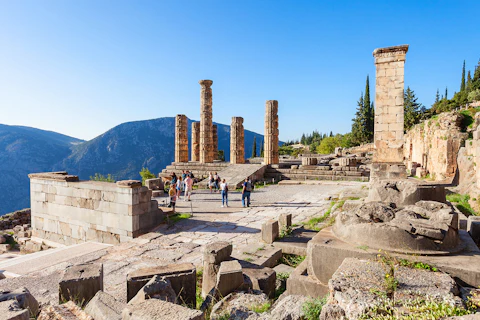
The Temple of Apollo, god of music, harmony, light, healing,
The Temple of Apollo, god of music, harmony, light, healing, and oracles occupied the most important and prominent position in the Delphic Panhellenic Sanctuary. The edifice with the partially restored colonnade visible today dates to the 4th century BC; it is the third temple built at the same place. The famous oracle, the Pythia, operated inside the temple, the location chosen, according to one tradition, due to a sacred chasm beneath the site emitting vapors, which were inhaled by the Pythia. Some ancient writers state that the Pythia then entered a state of delirium and uttering inarticulate cries, which were then turned into equivocal oracles by the priests. This interpretation is controversial, and has been challenged by scholars such as Joseph Fontenrose and Lisa Maurizio, who argue that the ancient sources uniformly represent the Pythia speaking intelligibly, and giving prophecies in her own voice.
1h - 9
Free time for lunch at a traditional Greek tavern with your
Free time for lunch at a traditional Greek tavern with your friends and family or shopping.
1h - 10
Free time for a coffee before we start our trip back to Athe
Free time for a coffee before we start our trip back to Athens.
30 min
Useful information
- Public transportation options are available nearby
- Infants are required to sit on an adult’s lap
- Specialized infant seats are available
- Suitable for all physical fitness levels
- Our drivers are not official tour guides, but they are knowledgeable and can provide fascinating commentary in fluent English. Although they will not enter the archaeological sites with you, they can answer all of your questions about the places you visit with this tour.
- Third party activities and especially extreme sports are not allowed during the tour. This can be a cause for immediate cancellation of the tour.
- This private tour is exclusively for your group, ensuring a personalized and flexible experience. Pickup time can be adjusted upon request. Your driver can pick you up and drop you off either at the same location or at different locations of your choice within Athens. * Hotel pickups: Your driver will be waiting in the hotel lobby. * Apartment pickups: Your driver will be waiting outside the building entrance. * Cruise port pickups: Your driver will meet you at the disembarkation gate, holding a sign with your name for easy identification. * Airport pickups: Your driver will be waiting in the arrivals hall holding a sign with your name. We monitor all incoming flights to ensure a timely pickup, even in case of delays.
- Mobile or paper ticket accepted
Cancellation policy
- More than 1 day before100% refund
- Between 0 and 1 days before0% refund
Prices by age band
- Adulto0-99 anni€47
Review distribution
- 574
- 44
- 30
- 21
- 10
Available options
With Greek Traditional Food
Lunch: Enjoy authentic Greek cuisine and traditional foods. Pickup included
Without food
Lunch: We will make a stop for lunch anyway, but it is not included in the price. Pickup included
More experiences in Delphi




Browse by theme
da