Ancient Olympia full day private tour from Athens
描述
亮点
- Full-day Tours
- Historical Tours
- Short term availability
- Additional fees
- Walking Tours
- Day Trips
- Private Sightseeing Tours
- Excellent Quality
- Luxury Car Tours
- Bus Tours
是什么让这次体验特别
语言向导
Inglese
包含接送
Raccolta in hotel / indirizzo
包含内容
已包含
- Private transportation
- Bottled water
- WiFi on board
- Professional drivers with deep knowledge of history (not licensed to accompany you in any site)
- Lunch (With Greek Traditional Food option)
- Air-conditioned vehicle
- Hotel/ airport/ port pickup and drop-off
不包含
- Licensed tour guide
- Gratuities
- Ancient Olympia & Olympia Archaeological Museum & Museum of the History of the Olympic Games (can be purchased on-site)
行程
- 1
The Corinth Canal connects the Gulf of Corinth in the Ionian
The Corinth Canal connects the Gulf of Corinth in the Ionian Sea with the Saronic Gulf in the Aegean Sea. It cuts through the narrow Isthmus of Corinth and separates the Peloponnese from the Greek mainland, arguably making the peninsula an island. The canal was dug through the isthmus at sea level and has no locks. It is 6.4 kilometres (4 mi) in length and only 21.4 metres (70 ft) wide at its base, making it impassable for many modern ships. From high up, you can enjoy the best view of Corinth's isthmus and admire the steep limestone walls while you observe the vessels below you navigate their way through the canal.
- 2
Olympia was a sacred place that attracted worshipers from ar
Olympia was a sacred place that attracted worshipers from around the ancient world. Starting from the 8th century BC, the religious celebrations at Olympia became associated with the Sacred Olympic Truce, honored throughout the Greek world following an agreement between the Spartan Lykourgos and the King of Elis, Iphitos. In the 5th century BC, Olympia became a place where ideas were spread, with dozens of thinkers and influential individuals coming here to exchange and pass on their knowledge and ideas.
- 3
The archaeological site held over 70 significant buildings,
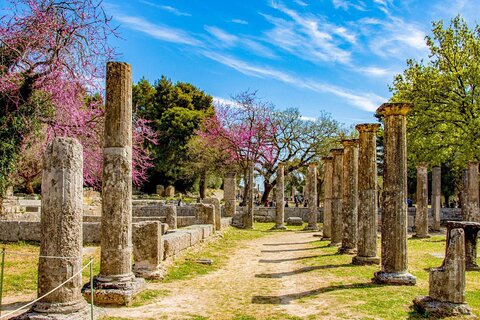
The archaeological site held over 70 significant buildings, and ruins of many of these survive. Of special interest to Greeks of all times is the Pelopion, the tomb of the quasi-mythical king, ancestor of the Atreids, the two kings who led their domains to war against Troy. The Peloponnesus is named for Pelops. The tomb suggests that he may not have been entirely mythical.
不含门票 - 4
The Temple of Zeus at Olympia was an ancient Greek temple in
The Temple of Zeus at Olympia was an ancient Greek temple in Olympia, Greece, dedicated to the god Zeus. The temple, built in the second quarter of the fifth century BC, was the very model of the fully developed classical Greek temple of the Doric order.
- 5
The stadium at the archaeological site of Olympia, Greece, i
The stadium at the archaeological site of Olympia, Greece, is located to the east of the sanctuary of Zeus. It was the location of many of the sporting events at the Ancient Olympic Games.
- 6
The Temple of Hera, or Heraion, is an ancient Archaic Greek
The Temple of Hera, or Heraion, is an ancient Archaic Greek temple that was dedicated to Hera, queen of the Greek gods. It was the oldest temple at Olympia and one of the most venerable in all Greece. It was originally a joint temple of Hera and Zeus, chief of the gods, until a separate temple was built for him. It is at the altar of this temple, which is oriented east-west, that the Olympic flame is lit and carried to all parts of the world. The torch of the Olympic flame is lit in its ruins to this day. The temple was built in approximately 590 BC, but was destroyed by an earthquake in the early 4th century CE.
- 7
Nymphaeum, “home of the Nymphs” or water goddesses was the o
Nymphaeum, “home of the Nymphs” or water goddesses was the official name of a water-distribution structure constructed in the mid-2nd century at that site to provide water to the masses who attended the Olympic Games in July and August. Nymphaeum was the general name throughout the Mediterranean for an ornate structure that terminated an aqueduct bringing water from distant elevated terrain, say a stream or copious springs. This one had substructures, statues, and ornately patterned stonework; its main purpose, however, was functional. It received water from the aqueduct into a cistern and released it by stages into a system of open and closed channels leading around the site. The end partaker of the water carried a secular patera, or small drinking bowl, around with him, dipping into an open trough for the water, as is suggested by the fact that at least some of the statues carried such paterae in one hand. Troughs went everywhere through the site to accommodate the crowds.
- 8
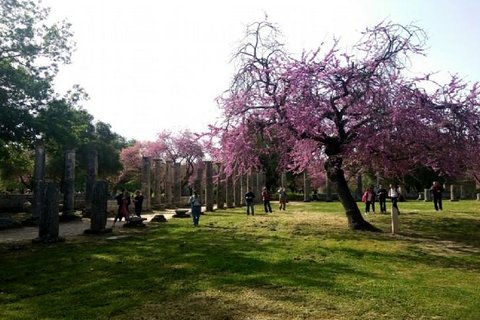
The palaestra is the ground or grounds in ancient Olympia wh
The palaestra is the ground or grounds in ancient Olympia where “pali” (“wrestling”) was taught and performed for training purposes, i.e. “wrestling-school”. Two other martial arts were taught there: Greek πυγμή (pygme), Latin pugnus, "fist, boxing," and Greek παγκράτιον, Latin pancration or pancratium, "any method," which was free-style, or hand-to-hand, including grappling, kicking, punching, or any unarmed method whatever, no holds barred. The latter was sometimes deadly, or disfiguring (with permission), which indicates that the arts were ephebic, or "soldier" training for prospective citizens of the city-state sponsoring the school, such as Elis, but here combined with prospective candidacy for contention in the games. Be that as it may, none of the games were conducted without rules, umpires, and judges, who did not hesitate to stop contests, fine contenders within some cases amounts prohibiting future participation, or bar flagrant violators.
- 9
The Philippeion in the Altis of Olympia was an Ionic circula
The Philippeion in the Altis of Olympia was an Ionic circular memorial in limestone and marble, a tholos, which contained chryselephantine (ivory and gold) statues of Philip's family: himself, Alexander the Great, Olympias, Amyntas III and Eurydice I. It was made by the Athenian sculptor Leochares in celebration of Philip's victory at the battle of Chaeronea (338 BC). It was the only structure inside the Altis dedicated to a human. The temple consisted of an outer colonnade of Ionic order with 18 columns. Inside it had nine engaged columns of the lavishly designed Corinthian order. It had a diameter of 15 meters. The naos contained two windows, much like Hera II at Paestum. It had a carved marble roof which was decorated with a bronze poppy head on top.
- 10
The Archaeological Museum of Olympia is one of the principal
The Archaeological Museum of Olympia is one of the principal museums of Greece, located in Olympia. It is overseen by the Ministry of Culture and Sports, and, as of 2009, is directed by Georgia Chatzi. When the original building was completed and opened in 1882, it was the first museum in Greece outside of Athens. The museum houses discoveries from the surrounding area, including the site of the Ancient Olympic Games. The collection includes objects produced and used in the area from prehistory to its time under Roman rule. The principal pieces in the museum are Hermes and the Infant Dionysus (attributed to Praxiteles), some objects from the Temple of Zeus, the Nike of Paionios, as well as an oenochoe that belonged to Phidias. The extent of its bronze collection makes it one of the most important in the world.
不含门票 - 11
The ancient Olympic Games were a series of athletic competit
The ancient Olympic Games were a series of athletic competitions among representatives of city-states and one of the Panhellenic Games of Ancient Greece. They were held in honor of Zeus, and the Greeks gave them a mythological origin. The first Olympic Games are traditionally dated to 776 BC. The games were held every four years, or Olympiad, which became a unit of time in historical chronologies. They continued to be celebrated when Greece came under Roman rule, 2nd century BC. Their last recorded celebration was in AD 393, under the emperor Theodosius I, but archeological evidence indicates that some games were still held after this date. The games likely came to an end under Theodosius II, possibly in connection with a fire that burned down the temple of the Olympian Zeus during his reign.
不含门票
有用信息
- Public transportation options are available nearby
- Infants are required to sit on an adult’s lap
- Specialized infant seats are available
- Suitable for all physical fitness levels
- Our drivers are not official tour guides, but they are knowledgeable and can provide fascinating commentary in fluent English. Although they will not enter the archaeological sites with you, they can answer all of your questions about the places you visit with this tour.
- Third party activities and especially extreme sports are not allowed during the tour. This can be a cause for immediate cancellation of the tour.
- This private tour is exclusively for your group, ensuring a personalized and flexible experience. Pickup time can be adjusted upon request. Your driver can pick you up and drop you off either at the same location or at different locations of your choice within Athens. * Hotel pickups: Your driver will be waiting in the hotel lobby. * Apartment pickups: Your driver will be waiting outside the building entrance. * Cruise port pickups: Your driver will meet you at the disembarkation gate, holding a sign with your name for easy identification. * Airport pickups: Your driver will be waiting in the arrivals hall holding a sign with your name. We monitor all incoming flights to ensure a timely pickup, even in case of delays.
- Mobile or paper ticket accepted
取消政策
- 提前1天以上100%退款
- 提前0–1天0%退款
按年龄段定价
- Adulto0-99 anni€80
评价分布
- 585
- 45
- 34
- 21
- 10
可用选项
With Greek Traditional Food
Lunch: Enjoy authentic Greek cuisine and traditional foods. Pickup included
Without food
Pickup included
Olympia的更多体验




按主题浏览
da